Projects
Sombrero Butte.
Overview
Sombrero Butte
Introduction
The Sombrero Butte Project is a 100% owned, early-stage porphyry copper exploration target located in the Bunker Hill Mining District, which sits at the intersection of two porphyry copper belts in Pinal County, Arizona, approximately 3km south of Faraday Copper's Copper Creek porphyry copper project, a development-stage asset that underscores Sombrero Butte's potential to host a large porphyry copper deposit. Arizona is a Tier 1 mining friendly, politically secure area with excellent and readily accessible infrastructure.
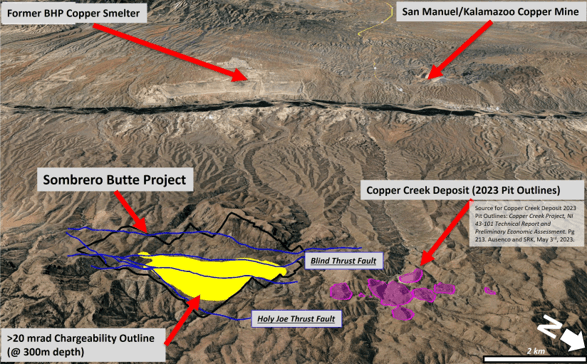
Sombrero Butte shares an identical geological setting to the Copper Creek porphyry deposit, including the Laramide age Copper Creek intrusive, widespread mineralized magmatic-hydrothermal breccia pipes (over 120 pipes mapped) and similar structural controls. Historical mining of these high-grade breccia pipes, widespread alteration and copper-molybdenum mineralization combined with the strong underlying chargeability anomaly suggests potential for a blind porphyry system, makes Sombrero Butte a highly prospective exploration asset in a Tier 1 mining jurisdiction.
Historical mining at the Magma Chief mine exploited high grade copper mineralization from magmatic-hydrothermal breccia pipes located in the northern end of the property. Historical drilling (2006-2008) of the breccia pipes intersected multiple intervals of high grade mineralization such as DDH SB-07-23 intersected a 60m core interval averaging 1.01% copper, 0.022% molybdenum, 0.067g/t gold and 3.01g/t silver from 446m to 506m and DDH SB-07-14 returned 1.16% copper over an 86m core interval from surface.
Property Description
Copper Fox through its subsidiary Desert Fox Sombrero Butte Co., owns 100% working interest in the Sombrero Butte project consisting of three Arizona Mineral Exploration Permits, 77 BLM mining claims and two patented mining claims covering approximately 1,389 ha.
Porphyry Footprint
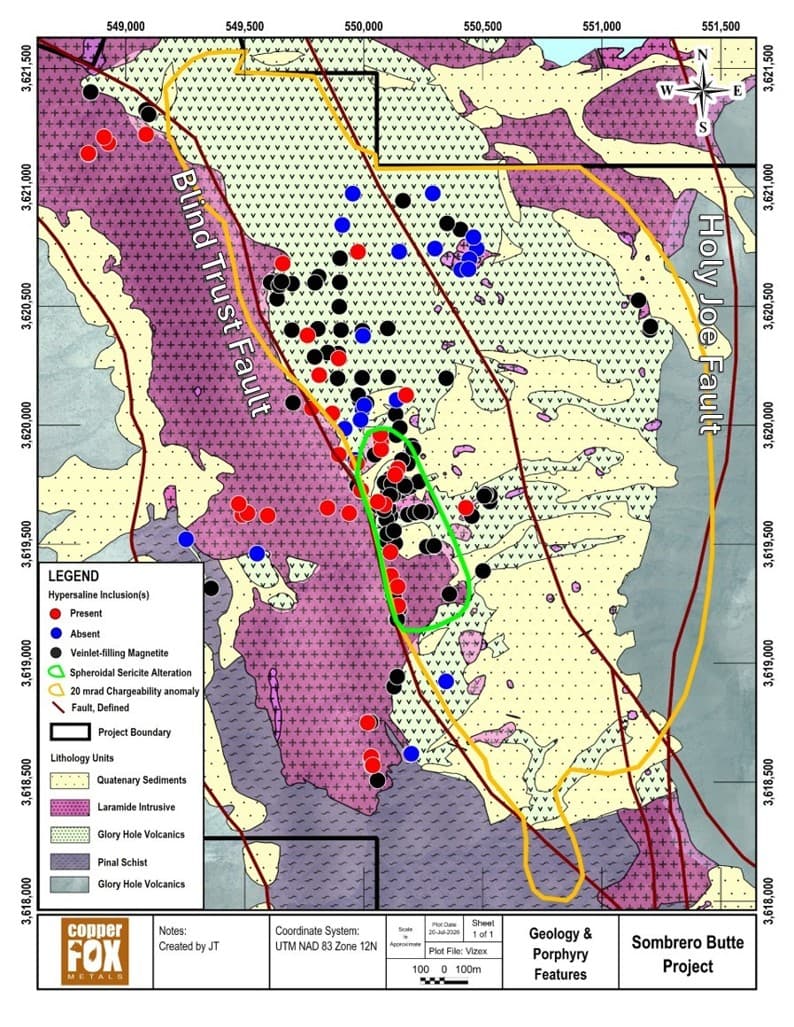
Exploration has defined a porphyry footprint indicative of a large, highly evolved, porphyry copper target with indications of hypogene enrichment and superimposed hydrothermal events that exhibits a strong spatial correlation to a large near surface underlying chargeability/resistivity anomaly (>10mv/v/20mrad).
The property geology consists primarily of Laramide age Glory Hole volcanics and underlying porphyritic and non porphyritic intrusive phases of the Copper Creek granodiorite, a composite, Laramide age weakly Peraluminous to Metaluminous calc-alkaline intrusive occupying the same regional structural setting as the Copper Creek porphyry copper deposit.
Copper-molybdenum mineralization occurs in steeply dipping, northeast trending quartz veinlets, fractures, and in breccia pipes with lesser amounts of disseminated chalcopyrite in the Copper Creek intrusive. The Glory Hole volcanics are characterized by large zones of moderate to intense bleaching and clay contained in a significantly larger zone of moderate to intense limonite staining due to weathering/oxidization of quartz-pyrite-sericite veinlets typically observed in the phyllic alteration zone. Mineralized, limonite stained leached, intensely clay altered breccia pipes and non-mineralized breccia pipes of magmatic hydrothermal origin are concentrated in the center of the porphyry footprint.
Key Porphyry Copper-Molybdenum Indicators
The convergence of multiple independent exploration vectors at the intersection of two prolific Laramide-age porphyry copper belts in Arizona that hosts the BHP's former San Manuel/Kalamazoo porphyry copper mine and the Copper Creek porphyry copper deposit are noteworthy features of the Sombrero Butte porphyry copper target. The porphyry features identified at Sombrero Butte that are typically observed in porphyry copper systems are listed below.
- Strategic location: at the intersection of two prolific Laramide-age porphyry copper belts in Arizona.
- Structural control: located between the Blind Thrust and Holy Joe fault systems.
- Favorable geology: porphyritic and non-porphyritic phases of hornblende-biotite granodiorite, biotite granodiorite quartz diorite, and quartz monzonite and multiple late-stage dikes of the Copper Creek granodiorite intrusive.
- Geophysical signature: a 3,200 meter (m) long by 1,300m wide chargeability anomaly (>20 mrad) associated with a moderate (200-500ohm) resistivity signature.
- Alteration: early stage potassic (+/- tourmaline) overprinted by spheroidal sericite and widespread phyllic (oxidized quartz-pyrite-sericite veinlets) alteration halo and lesser amounts of distal advanced argillic and propylitic alteration.
- Evolved system: superimposed high temperature hydrothermal events, i.e. sulphidization of magnetite, magnetite rimming pyrite and bornite rimming chalcopyrite (Hypogene enrichment).
- Boiling: widespread Hypersaline fluid inclusions with (liquid+ vapor+ daughter minerals) suggests the intrusive source achieved saturation and phase separation into a vapor-rich phase and a high salinity brine phase.
- Mineralized Breccias: multiple (120) mineralized (high grade copper +/- molybdenum-gold-silver) and non-mineralized, leached, bleached, intensely clay altered magmatic hydrothermal breccia pipes within the phyllic halo (quartz-pyrite-sericite veins).
- Near Surface target: widespread contact metamorphism suggests thin cover of Glory Hole volcanics overlying the porphyry target within the Copper Creek intrusive.
Photo Gallery
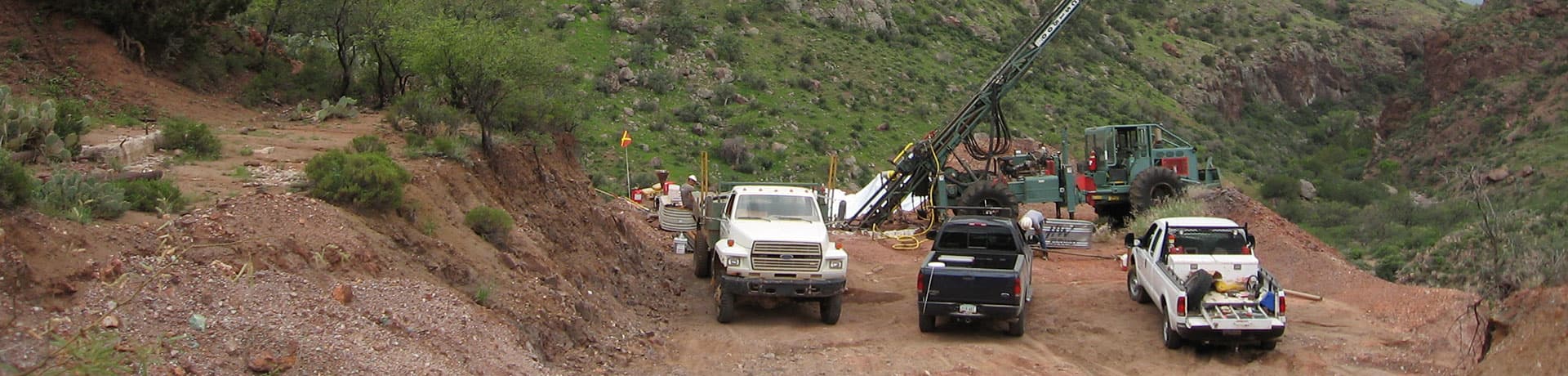
Sombrero Butte in the Field.
Explore Our Other Projects
Copper Fox Metals holds a focused portfolio of porphyry copper projects in Tier 1 mining jurisdictions across North America.